The Most Holy Theotokos - Throne of the King of Kings
The Most Holy Mother of God, the Theotokos, our Panagia, is central to Orthodoxy. Her significance to the Eastern Orthodox faith is witnessed by the over 500 names given to Her. This year’s auction focuses on Her title, the Throne of He Who is the King of Kings. The Theotokos is the Throne upon which Christ, the King of All, rested. In iconography, She is depicted in a way that visually presents Her as a throne, holding Christ.
The Throne symbolizes Her role in the divine Incarnation of Christ as was prophesized by Isaiah (7:14): Therefore, the Lord Himself will give you a sign: “Behold, the virgin shall conceive and bear a Son, and shall call His name Emmanuel," which means God is with us. Panagia is seen as the vessel through which Christ, The King of Kings, enters the world. As the Theotokos, the God-bearer, She is venerated for giving birth to the Messiah, serving as an intercessor, mediating between humanity and God for the salvation of our souls.
The Most Holy Mother of God came from a lineage of priests and royalty. The ancestors of Her mother, Saint Anna were priests. Saint Anna was the daughter of Matthan, a priest from the tribe of Levi, which included Aaron the High Priest. According to the ancient tradition of the Syriac Fathers transmitted through Byzantine and Arab Christian sources, Panagia’s father, Saint Joachim, was of noble descent from King David and the royal tribe of Judah. This genealogical connection carries historical significance. It is of supreme theological importance for it speaks of the ancient covenant made by God to David through the Prophet Nathaniel (2 Samuel 7:12-16): “Your house and your kingdom shall endure forever before Me; your throne shall be established forever." And again, in Jeremiah (23:5): “Behold, the days come, saith the Lord, when I will raise up to David a righteous branch, and a king shall reign and understand, and shall execute judgement and righteousness on the earth.” These prophecies and many others from the Old Testament testify to the promise that the Messiah would come from the line of David and were fulfilled in Jesus Christ, the Son of David. Yet Christ came not through David’s royal descendants in power and worldly majesty, but through the line of humble and righteous believers, Saints Joachim and Anna. He came not as a worldly king, but as the King of Heaven, born of a virgin. This incarnation transformed the expectation of worldly, political power and authority to one of spiritual and eternal authority.
The Old Testament prophecies similarily prefigure Panagia, of Her coming into the world and bringing forth the Messiah, in the divine Incarnation of Jesus Christ.
Ezekial (44:1-2): “Then he brought me back by the way of the outer gate of the sanctuary that looks eastward; and it was shut. And the Lord said to me, This gate shall be shut, it shall not be opened, and no one shall pass through it; for the Lord God of Israel shall enter by it, and it shall be shut". In his writings, Ezekial is prophesizing the Theotokos. He describes a gate in the Temple that remains shut, symbolizing the virgin birth of Panagia. The gate's sealing is viewed as a foreshadowing of Her as the Theotokos, or God-bearer.
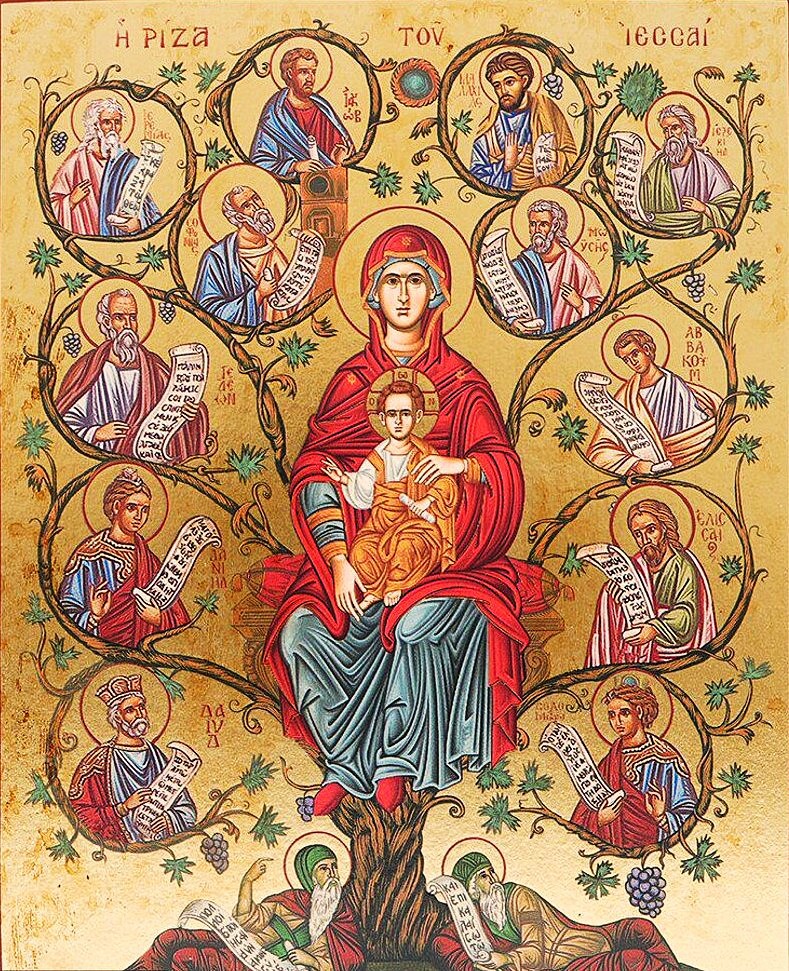
Εικόνα της Ρίζας του Ιεσσαί (Icon of the Root of Jesse)
In Isaiah, 11:1, The God-bearing role of the Theotokos is prefigured as the rod of Jesse that bore the blossom, Jesus Christ. Jesse was the father of King David.
“Και ἐξελεύσεται ῥάβδος ἐκ τῆς ρίζης Ἰεσσαί, και ἄνθος ἐκ τῆς ρίζης ἀναβήσεται.” – “And there shall come forth a rod out of the root of Jesse, and a blossom shall come forth from his root.”
The rod, a symbol of support and strength typifies Panagia as a source of strength, for we entreat her to strengthen and protect us in our trials. It is to Her that we flee after God Himself beseeching Her intercessions in danger, illness, in times of grief, and with thankfulness in times of joy. The Lord Jesus Christ, is the blossom, symbolizing hope and renewal.
Saint Cosmas composed hymns of Panagia as the rod by weaving in Old Testament prophecies: "Rod of the root of Jesse (Isaiah, 11:1), and flower that blossomed from his stem, O Christ, You have sprung from the Virgin. From the mountain overshadowed by the forest You have come (Habakkuk, 3:3), made flesh from her that knew not wedlock, O God, Who are not formed from matter."
Saint Andrew also speaks of the Virgin as the Rod and Christ as the Flower: "Let Jesse rejoice and let David dance, for behold, the Virgin, the Rod planted by God, has blossomed forth the Flower, even the everlasting Christ."
The underlying message in this prophesy is that God, the Creator of all, took on flesh out of the ‘roots’ that He Himself had created, in order that man be restored to his former glory.
In Saint Gregory Palamas’ homily on the Dormition of the Theotokos, he says of the Theotokos, “She also stands at God’s right hand, for where Christ sat in the heavens, that is, at the “right hand of majesty” (Heb. 1:3), there too She also takes Her stand, having ascended now from earth into the heavens.…. She is truly His Throne, and wherever the King sits, there His Throne is set also.” And Isaiah (Isaiah 6:1) beheld the throne amidst the choir of cherubim and called it “high” and “exalted” wishing to show how the position of the Mother of God far transcends that of the celestial hosts.
In the Theotokarion of Saint Nikodemos the Hagiorite, he says: “The Panagia is a Throne. She is the “living throne of God.” Saint Joseph the Hymnographer writes: “She is the “fiery throne of the Almighty".
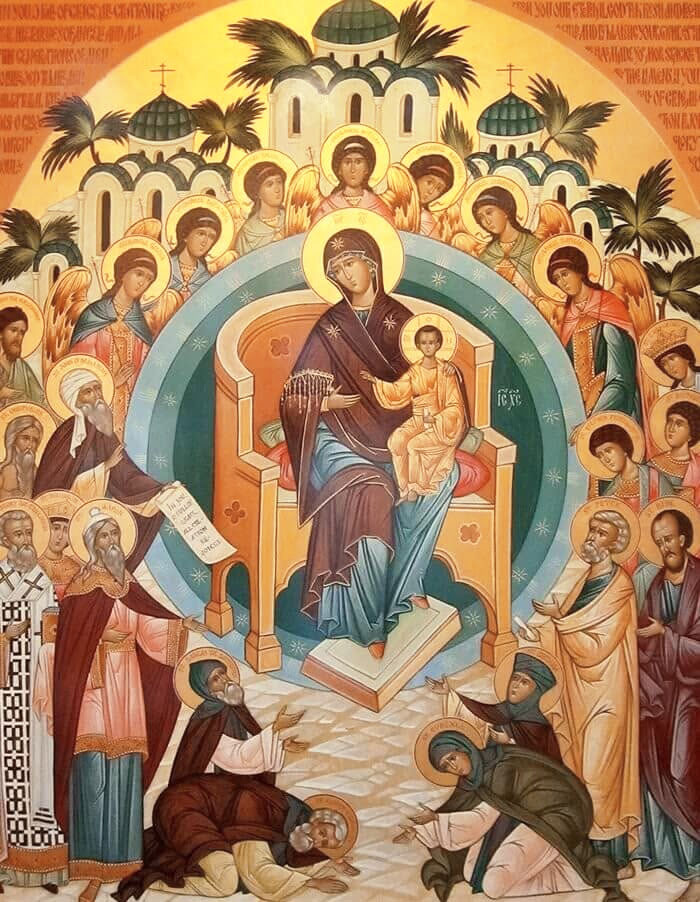
Εικόνα του Ακάθιστου Ύμνου (Icon of the Akathist Hymn)
In the Ακάθιστος Ύμνος (Akathist to the Mother of God), we chant:
“Χαῖρε, ὅτι ὑπάρχεις Βασιλέως καθέδρα, χαῖρε, ὅτι βαστάζεις τον βαστάζοντα πάντα.”
“Rejoice, for you are the throne of the King; Rejoice, for you hold him Who sustains everything.”
This year’s auction features unique icons of our Most Holy Theotokos, the Throne of He who is the King of Kings, our Lord and Savior Jesus Christ.
All auction icons were made at the Monastery and the proceeds go to support the
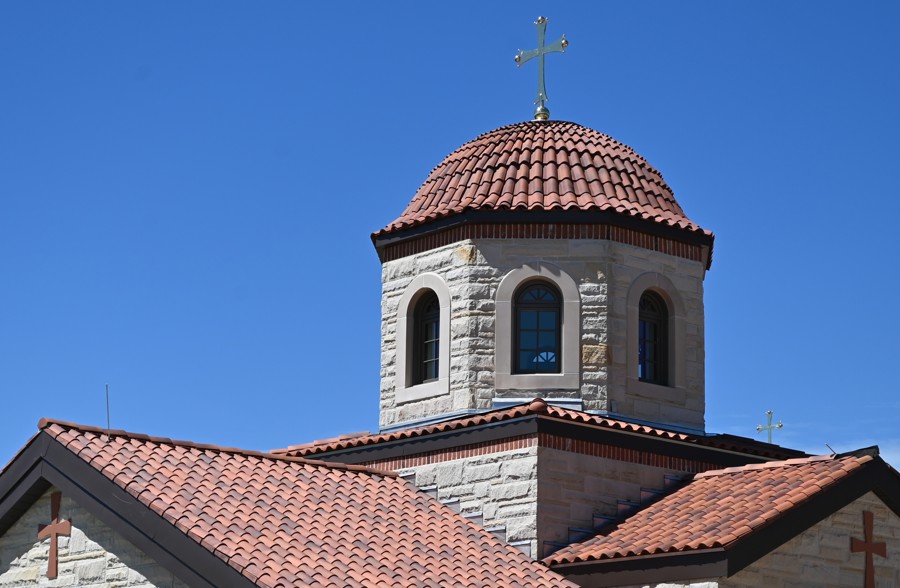
Monastery's new church dedicated to Saint Joseph The Hesychast.
All sales are final with no returns. The final bid price does not include shipping which will be calculated for each winning bidder's location. Winning bidders will receive a call within several days after the auction to arrange for shipping costs.